Best Of PNG ( Papua New Guinea )

Tag: Papua New Guinea

  • Wildlife of Papua New Guinea: A Guide to Its Unique Species

    Wildlife of Papua New Guinea: A Guide to Its Unique Species

    Papua New Guinea is home to a wide range of wildlife, much of it adapted to forests, mountains, rivers, and coastal waters. The country is remote in many areas, and its varied landscapes support species that are uncommon elsewhere.

    In this article, you’ll meet creatures from these habitats, including the 38 species of Birds of Paradise and the Matschie’s tree kangaroo. We name regions such as the Highlands and the Sepik River, where these animals may be seen. You’ll also learn about the island’s evolutionary history and how to reach remote areas through lodges such as Ambua Lodge or Karawari Lodge. This is a guide to seeing these animals with planning and local support.

    Key Takeaways

    • Learn how geographic separation influenced the wildlife of Papua New Guinea and its links to Asian and Australian fauna.
    • See the Birds of Paradise, including 38 species found in Papua New Guinea.
    • Look for tree kangaroos in the highlands and learn how these marsupials live in forest canopies.
    • Learn about reptiles such as the Saltwater Crocodile and Crocodile Monitor.
    • Review the travel arrangements involved in reaching remote lodges and wildlife areas.

    Evolution and Geography of Papua New Guinea Wildlife

    Papua New Guinea has areas of forest and mountain habitat that have experienced limited development. Its location between Asia and Australia has influenced the species found there. The country covers about 0.5% of the Earth’s land area and is home to 8% of all recorded vertebrate species. The absence of large placental predators, such as the big cats found elsewhere in Asia, influenced the development of its marsupials and other animals. The Fauna of New Guinea includes species with adaptations to particular habitats.

    The Gondwana Legacy

    The history of the wildlife of Papua New Guinea is linked to the island’s separation from the supercontinent of Gondwana. This separation from Australia millions of years ago left a marsupial population in a tropical climate. As the land shifted, a central mountain range rose to heights over 4,500 meters. The mountains divided habitats and contributed to differences between valleys and alpine grasslands. Lowland forests lie relatively close to high peaks, creating several habitat types within a limited area.

    Species with Limited Ranges

    Many species in this region are endemic, meaning they occur nowhere else on Earth. Geographic separation has also preserved lineages that are less common elsewhere. One example is the New Guinea Singing Dog, whose howl can be heard in some high-altitude forests. Smaller animals, including the “Cosmic Caterpillar” and other invertebrates, also form part of the wildlife of Papua New Guinea.

    • 8% of world vertebrates found on 0.5% of the globe’s landmass.
    • Zero large placental predators, a factor in marsupial evolution.
    • 4,500m peaks separating different habitats.
    • Species with long histories such as the Singing Dog found in isolated areas.

    Birds of Paradise in the Forest Canopy

    Birds of Paradise are a family of birds (Paradisaeidae) known for their plumage and courtship dances, with 38 of the 42 known species found in PNG. In some forests, visitors may begin before dawn and follow calls to a lek, the display ground where males compete for the attention of a mate. These birds are an important part of the wildlife of Papua New Guinea.

    Over time, sexual selection influenced the feathers and displays of these birds. Females favored particular features in potential mates, contributing to the development of wires, capes, and fans. Their feathers also appear in local traditions. During a Highland “Sing-Sing,” dancers may wear headdresses made from these feathers as symbols of cultural identity and ancestral pride.

    Iconic Species to Seek Out

    • The Raggiana Bird of Paradise: As the national symbol, this bird is well known. The males gather in the canopy and shake their orange plumes to attract females.
    • The Blue Bird of Paradise: Its cobalt feathers and long tail wires make it identifiable in the forest.
    • The Wilson’s Bird of Paradise: This species favors the forest floor. It has a turquoise cap and performs on a patch of earth it clears.

    Regions for Bird Watching

    The Tari Valley is a destination for those hoping to see several species in a single morning. Its range of elevations supports a variety of the wildlife of Papua New Guinea. In the high-altitude forests of Mount Hagen, you can search for the King of Saxony bird, which has two long head-wires that it can move independently. Ambua Lodge provides a base for bird watchers, with guides and access to suitable habitat. You can also explore our itineraries when planning a visit.

    Tree Kangaroos and Other Marsupials

    In the cloud forests of the Huon Peninsula and the Torricelli Mountains, the wildlife of Papua New Guinea includes the Tree Kangaroo, specifically Matschie’s and Goodfellow’s species. Unlike their Australian cousins that move across open plains, these marsupials live in trees. They are difficult to observe, and the Tenkile Conservation Alliance refers to them as the ghosts of the forest. They belong to a marsupial lineage with a long evolutionary history.

    Tree Kangaroo Adaptations

    A Tree Kangaroo’s shortened hind limbs and long tail help it balance in the forest. Curved claws allow it to grip wet bark. These animals are well camouflaged, and a local guide can help identify signs such as leaf movement and feeding patterns. Spotting one can be difficult.

    The Cuscus

    As the sun sets, nocturnal animals emerge. The Cuscus, including the spotted and silky varieties, is one of these animals. Its large eyes suit low light, and its prehensile tail helps it remain in the canopy while it feeds on fruit and leaves. You may find Cuscus near eco-lodges in regions such as the Highlands or the Sepik. Along with the Sugar Glider, it forms part of the nighttime wildlife of Papua New Guinea.

    • Tree Kangaroo: Found primarily in the Huon Peninsula and Torricelli Mountains.
    • Cuscus: Best viewed during guided night walks near eco-lodges.
    • Sugar Glider: Small, nocturnal marsupials known for their gliding membranes.
    • Conservation: The Tenkile Conservation Alliance protects 185,000 hectares of habitat.

    Wildlife of Papua New Guinea: A Guide to Its Unique Species

    Reptiles and Marine Life

    The wildlife of Papua New Guinea is also found in its rivers and in the waters of the Bismarck Sea. The saltwater crocodile is a major predator, and the Crocodile Monitor lives along riverbanks. This lizard can exceed 16 feet in length and may be larger than the Komodo Dragon in total size. It is rarely seen by outsiders.

    The Crocodile of the Sepik

    For communities along the Sepik River, the crocodile has spiritual importance. The “Crocodile Cults” of the Middle Sepik honor this connection through scarification rituals. Young men have their skin cut to resemble reptile scales as part of a rite of passage. Joining a Sepik River expedition offers an introduction to this heritage. Crocodiles also affect the river’s ecosystem by preying on other animals.

    Marine Life and Small Reef Species

    The Bismarck Sea lies in the Coral Triangle and supports a wide range of life. Kimbe Bay and Milne Bay host over 60 percent of the coral species found in the Indo-Pacific. This is one part of the wildlife of Papua New Guinea. Visitors can see:

    • Hammerhead sharks that patrol the walls of outer reefs in search of prey.
    • The epaulette shark, an endemic “walking shark” that uses its fins to move across shallow reefs at low tide.
    • Leatherback turtles, which return annually to nest on the volcanic beaches of New Britain.
    • Pygmy seahorses, which shelter among the branches of gorgonian fans.

    The Walindi Plantation Resort is a base for this marine region, with access to many dive sites.

    Planning a Wildlife Trip: Lodges and Logistics

    Many sites for observing the wildlife of Papua New Guinea are accessible only by private charter flights that land on grass strips. When mapping out remote wilderness trips, consulting independent travel-planning resources like safaribay.net can help travelers understand general expedition logistics before booking. Best of PNG organizes these journeys and supports community-led conservation through a leave no trace approach. For bird displays, plan your visit between May and October, when conditions are generally suited to watching courtship dances.

    Bensbach Wildlife Lodge

    In the Western Province, the Bensbach River floodplains include grasslands, waterways, and areas of woodland. You may see Rusa deer and wallabies, along with Pelicans, Pygmy Geese, and Sea Eagles. The wildlife of Papua New Guinea is accessible in parts of this region. You can visit through our Bensbach Wildlife Lodge package. The lodge follows a sustainable tourism approach.

    Expert-Led Itineraries

    Travel in the Bismarck Archipelago or the Highlands requires coordination of internal flights and access arrangements. We handle internal flight schedules and secure the tribal permits that grant access to protected ancestral lands. Local trackers lead visitors to bowers and nesting sites and interpret signs in the forest. Enquire about your wildlife journey today to plan your trip.

    Experiencing Papua New Guinea Wildlife

    The wildlife of Papua New Guinea includes Birds of Paradise, tree kangaroos, crocodiles, and many other species. The country’s geography has influenced the distribution of marsupials and river wildlife. Since 2010, Best of PNG has organized expert-led expeditions to these remote places, with attention to discovery and cultural respect.

    Our team provides access to remote outposts, including the high-altitude Ambua Lodge and the plains surrounding Bensbach. We specialize in underwater and birding photography, helping travelers document the wildlife. Begin your journey and explore our PNG wildlife expeditions.

    Frequently Asked Questions

    Where is the best place to see Birds of Paradise in Papua New Guinea?

    The Tari Valley in the Southern Highlands is a leading place to see the Raggiana Bird of Paradise in its natural habitat. You can also visit Varirata National Park, located 48 kilometers from Port Moresby, where 38 of the world’s 43 known species are found. These cloud forests offer a good view of courtship dances.

    Are there any dangerous animals in Papua New Guinea?

    The Saltwater crocodile and the Papuan Taipan are notable hazards within the wildlife of Papua New Guinea. Encounters are infrequent for travelers on guided expeditions. Our guides navigate the 800-kilometer Sepik River carefully and explain how to observe these animals from a safe distance.

    What is the best time of year for bird watching in PNG?

    June through October is a season for bird watchers because drier weather can improve visibility during breeding displays. During these five months, rainfall in the Highlands typically drops below 150mm per month, which may help with spotting the Blue Bird of Paradise. This period also provides access to remote lekking sites in the forest.

    Can you see kangaroos in Papua New Guinea?

    You can find 12 species of Tree Kangaroos in the high-altitude canopy of the Huon Peninsula and the Torricelli Mountains. These arboreal marsupials, such as the golden-mantled Matschie’s Tree Kangaroo, are found nowhere else on earth. Seeing one requires a trek into the primary rainforests above 1,000 meters.

    What makes the Sepik River wildlife unique?

    The Sepik River ecosystem is defined by its population of Saltwater crocodiles and over 400 species of birds along its 1,126-kilometer length. This floodplain supports the White-bellied Sea Eagle and the rare 12-wired Bird of Paradise. The wildlife here is linked to the local culture, where the crocodile is revered as a spiritual ancestor.

    Is it possible to see the New Guinea Singing Dog in the wild?

    Sighting a New Guinea Singing Dog in the wild is rare, with the first photographic evidence in decades emerging from the New Guinea Highlands in 2016. These canines inhabit the terrain of the Star Mountains at altitudes exceeding 3,500 meters. A 2020 expedition confirmed a small population, but the animals remain difficult to observe. For most travelers, hearing a howl at dawn is the closest connection to this animal.

    Do I need a special permit to visit wildlife conservation areas?

    Accessing protected zones like the 130,000-hectare YUS Conservation Area requires permissions granted by local landowners and community leaders. We manage these logistics so your visit supports the 50 villages dedicated to preserving the Matschie’s Tree Kangaroo. Respecting these customary land rights is part of an ethical journey and supports the wildlife of Papua New Guinea.

    What should I pack for a wildlife expedition in PNG?

    Pack 8×42 magnification binoculars and a 300mm telephoto lens to capture details of the forest canopy from a distance. Lightweight, moisture-wicking clothing is useful for the 85 percent humidity often found in the lowland jungles. Bring waterproof hiking boots for the muddy trails of the Owen Stanley Range, especially if you plan on traversing the rugged interior with Discover Kokoda Treks.

  • Tufi Resort Papua New Guinea: A Dive Guide to Fjordland Luxury

    Tufi Resort Papua New Guinea: A Dive Guide to Fjordland Luxury

    What if the most breathtaking fjords on Earth aren’t found in the freezing Arctic, but are carved into the vibrant, volcanic coastline of the Solomon Sea? For the discerning traveler, Tufi Resort in Papua New Guinea represents more than just a destination; it’s a sanctuary where prehistoric landscapes meet refined tropical luxury. You likely understand that finding a truly untouched corner of the world often comes with a trade-off in comfort or safety. It’s natural to feel a sense of hesitation when planning a journey into the remote Oro Province, especially when you’re seeking a connection that feels authentic rather than staged.

    We agree that your precious time shouldn’t be spent navigating logistical hurdles or settling for "tourist traps" that lack soul. This guide promises to demystify the journey, showing you how we’ve curated a seamless experience that bridges the gap between rugged adventure and sophisticated ease. You’ll discover how to access 40 exclusive dive sites where the visibility often exceeds 40 meters; you’ll also learn how to engage with the local Oro communities through our established 20-year heritage of respectful tourism. We’re pulling back the curtain on the perfect itinerary, from the emerald depths of the fjords to the pristine outer reefs that remain some of the best-kept secrets in the diving world.

    Key Takeaways

    • Journey through the prehistoric grandeur of Cape Nelson’s tropical fjords, where emerald-clad cliffs drop 120 meters into the pristine waters of the Solomon Sea.
    • Discover why the “Outer Reefs” are a diver’s sanctuary, offering 40-meter visibility and a rare mix of pelagics and diverse macro life.
    • Connect with the soul of Oro Province through authentic village immersions and the delicate, time-honored tradition of Tapa cloth artistry.
    • Experience the refined comfort of Tufi Resort Papua New Guinea, where boutique luxury and organic, fjord-side dining meet the edge of the wild.
    • Navigate the logistics of your expedition with expert guidance on internal flights and the importance of a bespoke itinerary for a seamless adventure.

    The Geography of Wonder: Exploring the Tropical Fjords of Tufi

    Perched atop a basalt ridge, the Tufi Resort overlooks a landscape that defies conventional tropical geography. Here, the coast of Cape Nelson doesn’t just meet the sea; it plunges into it with a dramatic intensity. These ancient volcanic fingers, technically known as "rias," create deep-water canyons that stretch inland for miles. You’ll stand on 120-meter vertical cliffs where the emerald canopy of the rainforest meets the sapphire depths of the Solomon Sea. It’s a 180-degree panorama of geological power that feels like a prehistoric secret whispered to the modern traveler.

    Planning an expedition offers a unique window into this corner of the Oro Province. As global travel trends shift toward deeper immersion, Tufi stands as a bastion of authentic discovery. While the region feels like the edge of the known world, it’s remarkably accessible via a 50-minute flight from the capital, Port Moresby. This short hop transports you from the urban bustle to a wilderness that has remained largely unchanged for millennia. The season is particularly significant as the resort celebrates its role as a premier gateway to the Solomon Sea, offering logistics that bridge the gap between rugged adventure and curated comfort.

    The Prehistoric Allure of Oro Province

    The fjord walls are draped in a ancient rainforest, where the calls of the Raggiana Bird of Paradise  and the Greater Hornbill echo across the water. This landscape was forged by the historic eruptions of Mt. Victory and Mt. Trafalgar, volcanic giants that shaped the deep inlets over thousands of years of seismic activity. The Tufi fjords represent the one of the few tropical fjord systems found anywhere on the planet. This intersection of volcanic history and vibrant biodiversity creates an ecosystem where rare orchids cling to limestone outcrops just feet above coral-fringed shorelines. It’s a place where the earth’s ancient past is visible in every jagged cliff and shadowed cove.

    Climate and the Best Time to Visit

    Timing is everything when exploring the "Scandinavia of the Tropics." The dry season, spanning from May to October, provides the crispest visibility for those looking to capture the scale of the cliffs and the clarity of the water. During the "calm season" between October and April, the Solomon Sea often resembles a mirror. This glass-like surface is perfect for sea kayaking into the furthest reaches of the fjords where the water is so still it reflects the clouds with startling precision.

    Tufi resort benefits from a distinct micro-climate that differs significantly from the humid, heavy air of Port Moresby. Coastal breezes funnel through the rias, naturally cooling the air and providing a refreshing reprieve for explorers. Key climate features for your itinerary include:

    • Optimal Visibility: Year-round the outer reefs offer 30-meter plus underwater visibility.
    • Kayaking Conditions: November to April provides the lowest wind speeds for fjord exploration.
    • Temperature Regulation: Average daytime highs hover around 29°C, tempered by the unique fjord topography.

    World-Class Diving: From Volcanic Reefs to WWII Wrecks

    Beneath the glass-like surface of the Solomon Sea, Tufi reveals a dual personality that captivates even the most seasoned divers. The volcanic activity that carved these dramatic fjords also birthed a complex underwater topography where deep-sea seamounts meet sheltered, sediment-rich basins. Exploring the waters around Tufi Resort offers a rare chance to witness 40-meter visibility on offshore reefs before retreating to the nutrient-dense shadows of the fjords for world-class macro photography. The marine biodiversity here is staggering, with over 40 offshore sites providing a home to everything from scalloped hammerheads to delicate, neon-hued nudibranchs.

    The Outer Reef Experience

    Over 40 pristine offshore sites await just a 20 to 50-minute boat ride from the shore. These seamounts rise abruptly from the ocean floor, attracting pelagic giants like manta rays and grey reef sharks. Cyclone Reef stands out for its vibrant coral gardens and massive sea fans, while Mulloway offers a high-voltage experience with schooling barracuda and patrolling tuna. Divers should be prepared for varying current conditions; while many sites are accessible to intermediates, the deep walls and stronger surges often require the confidence of an advanced certification. The thrill of hovering over a 600-meter drop-off while watching a hammerhead cruise the blue is a signature Tufi moment.

    History rests heavily on the seabed here. The B-17 "Black Jack" remains one of the most significant WWII wreck sites in the Pacific. Resting at a depth of nearly 50 meters since its crash in 1943, the aircraft is remarkably intact. Divers can still see the cockpit instruments and the machine guns, providing a hauntingly beautiful monument to the region’s wartime heritage. This site is strictly for technical or highly experienced deep divers due to its depth and remote location.

    Muck Diving and Macro Photography in the Fjords

    The inner fjords provide a stark, fascinating contrast to the sapphire water of the outer reefs. Volcanic sediment and organic runoff create a specialized habitat for the ocean’s most eccentric residents. This "muck" environment is a secret sanctuary where the small and the strange thrive in the silt.

    • Mandarin Fish: These psychedelic beauties perform their intricate mating dances at dusk right under the resort jetty.
    • Ghost Pipefish: Look closely at the crinoids to find ornate ghost pipefish perfectly camouflaged against the reef.
    • Mimic Octopus: The soft fjord floor is the perfect stage for these masters of disguise to hunt.

    For those documenting this hidden world at Tufi, a dedicated macro lens and a strobe are essential. The fjord sediment can be easily disturbed, so good buoyancy is required to capture the perfect shot without "backscatter" in your frames. If you’re ready to descend into these pristine waters, you can start planning your expedition with our expert. The house reef is a legendary spot for these encounters, accessible just steps from the dive shop at any time of day.

    The Cultural Heartbeat: Village Immersion and Oro Traditions

    Beyond the volcanic peaks and the sapphire depths of the fjords, the true soul of this region resides within its people. Tufi Resort operates on a philosophy of integration, where tourism acts as a vital bridge for sustainable development across the Oro Province. This isn’t a passive observation of a culture; it’s an invitation to step into a way of life that has remained largely unchanged for centuries. Travelers glide through the deep, jungle-clad arms of the fjords in traditional outrigger canoes, guided by the very people whose ancestors first navigated these waters. The "Sing-Sing" is the pinnacle of this connection, a vibrant explosion of feathered headdresses and rhythmic drumming that serves as a spiritual vessel for oral histories and social bonding.

    The Village Stay Experience

    Best of PNG curates these encounters to ensure they remain respectful and profoundly authentic. Guests can choose to spend 24 to 48 hours in traditional guest houses in villages like Kofure, Orotoaba, or Garewa. These stays offer a stark, beautiful contrast to the amenities of the main resort. You’ll wake to the sound of the tropical dawn and spend your day witnessing village life; artisanal fishing, diving for lobster,  the process of sago-making, a staple food source that requires hours of labor to extract from the palm heart or visiting waterfalls. Local hosts demonstrate traditional line fishing techniques, sharing secrets of the reef that have been passed down through generations. It’s a raw, unfiltered look at life in the fjords.

    Tapa Cloth: The Living Art of the Oro People

    The artistry of the Oro people is most famously captured in Tapa cloth, a textile created from the beaten inner bark of the paper mulberry tree. This practice dates back centuries and remains a primary identifier of clan heritage. Each piece is unique, featuring one of the 50 documented clan patterns hand-painted with natural dyes derived from charred husks and forest berries. When you visit a village, you witness the rhythmic thud of the wooden beaters and the steady hand of the artists. Purchasing these textiles directly provides 100 percent of the proceeds to the village artisans, ensuring this ancient craft survives as a viable economic pillar for the local community.

    To fully appreciate the depth of this cultural landscape, visitors should focus on these key elements of the Tufi experience:

    • Sustainable Impact: Direct financial support for surrounding villages through curated stays.
    • Ancestral Navigation: Exploring the "tropical fjords" via hand-carved outrigger canoes.
    • Artistic Legacy: Understanding the specific clan motifs used in Tapa cloth production.
    • Ritual Connection: Participating in a Sing-Sing to witness the spiritual power of dance.

    Tufi Resort Papua New Guinea: A Dive Guide to Fjordland Luxury

    Boutique Luxury in the Wild: Resort Amenities and Comfort

    Tufi Resort Papua New Guinea isn’t just a place to sleep; it’s a sanctuary perched on a volcanic ridge overlooking the Solomon Sea. The historical main lodge, built with a colonial charm that echoes the region’s heritage, serves as the heartbeat of the property. Here, the small-scale approach limits the guest count to approximately 40 travelers at any given time. This deliberate intimacy ensures an exclusive atmosphere where the staff knows your name and your specific preferences. Much like reserving private villas and high-end retreats across premier global destinations via luxurybookings.ae, guests here experience uncompromising privacy and personalized service, though carved into one of the most rugged landscapes on earth. Go outside the diving season, and you could have the place to yourself.

    The resort facilities bridge the gap between adventure and relaxation. A swimming pool offers a cool respite, while the dive center stands ready with modern equipment and guides who have logged over 5,000 dives in these specific waters. This infrastructure provides a vital safety net for exploration, allowing you to push your boundaries while knowing a hot shower and a curated cocktail await your return to the ridge.

    Accommodations Designed for Immersion

    The resort has refined its offerings into three distinct tiers that prioritize both aesthetics and function. The Deluxe Bungalows are the crown jewels of the property, featuring polished local timber floors and expansive screened-in porches that invite the rhythmic sounds of the rainforest inside. These units are strategically positioned to provide 180-degree panoramic views of the fjords, making them the premier choice for photographers and honeymooners. Standard rooms offer a more modest but equally authentic experience, maintaining the traditional PNG architectural style, and Deluxe Rooms bridge the gap. Every room now includes essential modern comforts, such as air conditioning and Wi-Fi, ensuring you stay connected even while submerged in the wilderness.

    Gastronomy at the Edge of the World

    Dining at the resort is a vibrant celebration of the Oro Province’s natural bounty. The "fjord-view" dining room operates on a farm-to-table philosophy, sourcing its seafood directly from local artisanal fishermen who bring their daily catch to the resort wharf each day. You’ll find a sophisticated fusion of PNG staples like taro and sweet potato paired with Western culinary techniques. The menu changes daily based on what the ocean provides, often featuring yellowfin tuna or mud crab caught just hours before service.

    • The Social Terrace: Dinner under the stars creates a communal atmosphere where divers and hikers swap stories of the day’s discoveries.
    • Dietary Flexibility: Despite the remote location, the kitchen manages complex dietary requirements with at least 48 hours’ notice.
    • Organic Produce: Most vegetables are grown in nearby village gardens, providing a crisp, chemical-free flavor that’s hard to find in urban centers.

    The experience of sipping a chilled glass of wine while watching the sunset paint the fjord walls in shades of ochre is a highlight of any stay at Tufi Resort. It’s a moment of peace that justifies the journey to this distant corner of the globe. You’re not just a tourist here; you’re a guest in a home that respects the land it occupies.

    Ready to experience the perfect blend of adventure and elegance? Contact Best of PNG to secure your preferred bungalow and start planning your bespoke expedition today.

    Planning Your Tufi Expedition with Best of PNG

    The journey to the fjords is a transition between worlds. Reaching Tufi requires more than a simple booking; it demands an understanding of the rhythm of the Pacific. Most travelers arrive via Port Moresby, where Jacksons International Airport serves as the essential gateway. From here, a spectacular flight over the Owen Stanley Range delivers you to the grass airstrip at Tufi, where the air smells of salt and ancient rainforest. We act as your knowledgeable bridge, ensuring that the logistical complexities of this rugged wilderness never overshadow the magic of your discovery.

    Navigating PNG Logistics

    Domestic flight schedules in Papua New Guinea continue to be influenced by tropical weather patterns and shifting operational demands. We mandate a 24-hour buffer day in Port Moresby for all our guests to protect against unforeseen delays. This isn’t just a safety measure; it’s a moment to breathe before plunging into the wild. Our team manages every domestic leg and ground transfer. While we rarely sell international airfares—which travelers often arrange through a full-service agency like Superior Cruise and Travel—we manage all local transfers to ensure your transition from the capital to the coastal fjords is effortless. You won’t have to worry about reconfirming bush flights or finding reliable transport through the city; we handle the mechanics so you can focus on the horizon.

    Crafting Your Bespoke Itinerary

    A short visit to this region can feel like a fleeting dream if not curated with care. A 7-day expedition focused solely on Tufi Resort allows for immersion into the dive sites and the intimate hospitality of Oro Province village stays. However, for those with 14 days to explore, we recommend a multi-region odyssey that highlights the country’s startling diversity.

    • The Highland Connection: Pair the coastal stillness of Tufi with the thunderous drums of the Mount Hagen Cultural Show held every August.
    • River and Reef: Combine the fjord landscapes with a private charter through the spirit houses of the Sepik River.
    • The Oro Specialist: We understand the nuances of the local clans and the seasonal visibility of the reefs, ensuring you are in the right place at the precise moment the light hits the water.

    Every itinerary we build is a personal voyage. We value authenticity over superficial sightseeing, connecting you with heritage that remains unspoiled by modern footprints. Whether you are chasing the rare Queen Alexandra’s Birdwing butterfly or descending into the depths of a pristine reef, your journey is curated for safety and profound connection.

    Start planning your bespoke Tufi adventure today with Best of PNG and step into a world that time has gracefully overlooked.

    Secure Your Place in the Fjords of Tufi

    Your journey to the last frontier begins where the emerald peaks of the Oro Province meet the Solomon Sea. Tufi Resort offers a rare fusion of vertical tropical fjords and over 40 pristine dive sites. You’ll move from the deep silence of volcanic reefs to the vibrant rhythm of village life, where ancient traditions remain the heartbeat of the land. This is a landscape that demands reverence and rewards the curious traveler with memories that never fade.

    Navigating these remote waters requires more than just a map; it demands the specialized insight of a curator. Christopher Bartlett brings over 20 years of photographic and expedition expertise to every itinerary, ensuring your voyage is defined by seamless logistics and cultural immersion. We handle the details of PNG  travel so you can focus entirely on the wonder of discovery. The beauty of the fjords is waiting for those ready to step beyond the map. Explore our curated Tufi Resort packages and begin your voyage into the heart of the wild. Your most meaningful adventure is just over the horizon.

    Frequently Asked Questions

    Is Tufi Resort safe for solo travelers and families?

    Tufi Resort remains one of the safest and most secluded sanctuaries in Papua New Guinea. The resort operates with a dedicated 24-hour security presence and maintains deep, generational ties with the surrounding Oro Province communities. This mutual respect ensures a tranquil environment where solo travelers and families wander through the village or kayak the fjords with total peace of mind. It’s a place where the local heritage creates a protective, welcoming embrace for every guest.

    How do I get to Tufi Resort from Port Moresby?

    You reach the resort by booking a scheduled 50-minute flight from Port Moresby via Tropic Air. These flights typically depart twice a week, landing on a colonial-era gravel airstrip located just 400 meters from the resort entrance. It’s a breathtaking aerial journey over the Owen Stanley Range that transitions you from the capital’s bustle to the pristine silence of the fjords in under an hour. This short hop is the gateway to an untouched wilderness.

    What is the best time of year for diving at Tufi Resort?

    The peak season for diving at Tufi Resort Papua New Guinea runs from October through April when the Bismarck Sea is remarkably calm. During these months, underwater visibility frequently exceeds 40 meters, and water temperatures hover at a comfortable 29 degrees Celsius. You’ll find the outer reefs teeming with pelagic life, offering crystal-clear glimpses into a vibrant marine world. This period provides the most reliable conditions for exploring the deep, vertical walls of the ancient fjords.

    Do I need to be an advanced diver to enjoy Tufi?

    You don’t need to be an advanced diver to enjoy the underwater wonders of this region. While the deep outer reefs appeal to veterans, the resort’s house reef and sheltered fjords offer calm, shallow waters perfect for Open Water divers or snorkelers. The onsite PADI dive center provides 5 distinct certification courses. This ensures even novices safely explore  the colorful coral gardens that thrive just meters from the wharf.

    What should I pack for a Tufi Resort and village stay trip?

    Pack lightweight, breathable tropical clothing and a pair of sturdy reef shoes for your village immersion. You’ll need a 30+ SPF reef-safe sunscreen to protect the delicate ecosystem and a 10-liter dry bag for fjord excursions. For village stays, bring a modest sarong and a high-quality headlamp with 200 lumens of brightness. These tools help you navigate the authentic, unlit paths of the Oro Province after sunset while respecting local traditions and the natural environment.

    Can I see Birds of Paradise at Tufi Resort?

    You can definitely see the iconic Raggiana Bird of Paradise during early morning hike from Orotoaba village after an overnight stay in the guesthouse there. Local guides lead expeditions to known lekking sites located within a 45-minute hike from the village. You can see numerous males competing for attention in the high canopy with their spectacular plumage and rhythmic calls. It’s a rare, evocative encounter with nature’s most beautiful performers.

    Are there malaria risks in the Tufi area, and what precautions are needed?

    Malaria is present in the Oro Province, so you should consult a travel doctor for a prescription of prophlyaxis. The resort minimizes risk through regular spraying and provides high-quality mosquito nets in every guest room. Wear long sleeves during the dusk hours when mosquitoes are most active. Apply a repellent containing DEET to ensure your journey remains focused on discovery rather than health concerns.

    Is there Wi-Fi and cell service available at the resort?

    Tufi Resort Papua New Guinea offers satellite Wi-Fi in the main lodge area, though speeds are modest and best suited for checking emails. You’ll find that 4G cell service via the Telikom network is accessible near the airstrip and the main building. It’s a deliberate chance to disconnect from the digital world and embrace the rhythmic pulse of the wilderness. Essential connectivity remains available for 24-hour peace of mind, but the true luxury is the unspoiled silence.

  • How to Plan a Trip to Papua New Guinea: The 2027 Guide

    How to Plan a Trip to Papua New Guinea: The 2027 Guide

    What if the main barrier to your next adventure isn’t the terrain of the Highlands, but the outdated idea that this region is impossible to navigate? You may be drawn to the Sepik River or the plumes of a Huli Wigman, yet concerns about safety and flight reliability often stall the plan before it begins. It’s understandable to feel hesitant when faced with a land of 800 cultures and remote lodges that don’t appear on standard booking sites. This is why we’ve written a framework to plan a trip to Papua New Guinea, turning a complex puzzle into a manageable 2027 trip.

    We aim to take you beyond sightseeing into a closer look at the country, where every tribal encounter is handled with respect and care. You’ll gain a clear 10 to 14-day roadmap that explains internal travel and gives you access to events like the Mt Hagen Cultural Show. This guide covers the timing, the lodges, and the safety protocols you need to travel with confidence.

    Key Takeaways

    • Understand why 2027 is a good time to visit through sustainable, expedition-style travel.
    • Learn the logistics to plan a trip to Papua New Guinea that balances the traditions of the Highlands with the Sepik River.
    • Gain clarity on safety protocols by understanding the differences between urban Port Moresby and the remote provinces.
    • Identify the 12-month planning milestones required to secure your place at the Mount Hagen or Goroka cultural festivals.
    • Discover how access to wildlife lodges and expedition vessels combines modern comfort with local heritage.

    Why 2027 is the Year to Plan Your Papua New Guinea Expedition

    Papua New Guinea remains one of the least visited destinations in the Pacific. As we look toward 2027, travel is shifting away from crowded hubs toward less visited places. Sustainable, expedition-style tourism is meeting the long-established rhythms of the land. It’s a good time to plan a trip to Papua New Guinea because the infrastructure for boutique eco-lodges has matured without losing the rugged character of the region.

    Understanding this vast island requires a framework we call the Three Worlds. To truly grasp the complexity of Papua New Guinea, you must navigate the mist-shrouded Highlands, the winding arteries of the Sepik River, and the vibrant coral cathedrals of the Coastal Reefs. Embracing slow travel isn’t just a recommendation; it’s a necessity. Moving at a deliberate pace ensures you respect the deep-rooted heritage of the 851 distinct languages that call this terrain home.

    The Last Frontier of Authentic Discovery

    In 2027, the appeal of the untouched remains strong. You’ll find landscapes that look much as they did a millennium ago, from limestone peaks to dense rainforest. Many cultures here have remained largely unchanged for centuries. A Sing-Sing is a living heritage event of ancestral pride and tribal identity rather than a performance staged for an audience.

    Choosing Your Primary Focus: Culture, Nature, or Adventure

    Your journey should reflect your interests. Whether you’re tracking the Raggiana Bird of Paradise or diving in Kimbe Bay, every itinerary can be tailored. Most travelers find these interests overlap; a morning spent with the Huli Wigmen often leads to an afternoon of birding in the high canopy. When you plan a trip to Papua New Guinea, you must choose between expert-led expeditions and the logistics of self-guided travel. Local knowledge is the key to the bush, which makes curated journeys the sensible choice for 2027—whether booking through specialized local operators or partnering with boutique travel design studios like Luxe Adventures to craft a seamless, bespoke itinerary.

    Mapping the Three Worlds: Highlands, Sepik, and Pristine Coasts

    To plan a trip to Papua New Guinea is to navigate three distinct realms that feel entire worlds apart. You’ll find yourself moving from mist-shrouded peaks to winding river systems and finally to some of the planet’s most vibrant coral gardens. Achieving a balanced 12-day itinerary requires a strategic approach to internal flights, often connecting the emerald valleys of the interior with the turquoise fringes of the Bismarck Sea.

    The Highlands: Warriors and Ancient Festivals

    The Highlands are central to Melanesian culture. In August 2027, the Mount Hagen Cultural Show will bring together over 80 distinct tribes in a display of feathers, shells, and ochre. Staying at Ambua Lodge provides a high-altitude base at 7,000 feet to meet the Huli Wigmen, who spend years growing their hair into ceremonial wigs. Nearby, the Asaro Mudmen and the Skeleton Tribes of Chimbu offer glimpses into ancestral legends that have survived for millennia.

    The Sepik River: A Voyage into the Spirit World

    The Sepik River is a 1,126-kilometer artery of artistic expression and spiritual depth. An expedition cruise here isn’t just a boat ride; it’s a passage through a living gallery. In the Middle Sepik, the towering Haus Tambaran (Spirit Houses) serve as the center of village life. This is where the crocodile scarification rituals still honor the river’s most feared predator. The intricate woodcarvings you’ll find in villages like Palembei are world-renowned, frequently sought after by international collectors for their raw, evocative power.

    The Bismarck and Solomon Seas: Marine Biodiversity

    Kimbe Bay contains roughly 76% of the world’s coral species, making it a pilgrimage site for serious divers. Walindi Plantation Resort serves as the legendary base for exploring these waters, while the MV FeBrina takes guests to the remote, current-swept Fathers Reefs. In Milne Bay, the focus shifts to "macro" diving, where you’ll search for rare nudibranchs and pygmy seahorses in the sand. Tufi Resort offers a different pace altogether, where deep volcanic fjords meet traditional coastal life, allowing for a mix of world-class reef diving and authentic village stays.

    To experience the full spectrum of this wilderness, we recommend a 12-day route that pairs the Highlands festivals with a week of coastal immersion. You can

    Explore our 2027 departure dates.

    To plan a trip to Papua New Guinea requires a shift in perspective, moving away from conventional tourism toward cultural respect and logistical care. In 2027, safety remains the most frequent question from travelers. While headlines often focus on Port Moresby, the situation in the remote provinces is one of hospitality. The islands and highlands operate under a different social code, where guests are treated with great respect.

    Central to this experience is the Wantok system, an ancient social contract based on shared language and kinship. When you travel with us, you’re essentially brought into this circle of protection. It’s a living heritage that ensures your presence is honored rather than merely tolerated. Local communities take immense pride in hosting visitors, viewing your journey as a bridge between their ancestral traditions and the outside world.

    Demystifying Safety: Reality vs. Perception

    Tribal dynamics in the Highlands are often misunderstood by international media. These localized disputes over land or resources are internal and never involve or target travelers. In 2027, the primary strategy for safety is simple: avoid the friction of urban centers and move toward the countryside. We recommend using Loloata Island Resort as your Port Moresby hub, which offers a private island just 20 minutes from the airport, bypassing the city’s congestion. For a broader perspective on the cultural landscape, National Geographic’s guide to Papua New Guinea offers context on the diversity you’ll encounter. Always use private, pre-arranged transfers and stay within the network of reputable lodges to keep your journey secure.

    The Critical Role of Expert-Led Curation

    Attempting a DIY approach in Melanesia often leads to logistical problems. In a country where infrastructure is limited and 85 percent of the population lives in rural settings, local expertise is a major asset. Weather patterns in the Sepik or flight delays in Mount Hagen can disrupt a poorly planned itinerary. Expert curators don’t just book rooms; they manage the changing nature of Pacific travel. They understand how to adjust when a tropical front moves in or when a village festival changes dates. This is why traveling with an established operator is the most reliable way to plan a trip to Papua New Guinea.

    How to Plan a Trip to Papua New Guinea: The 2027 Guide

    The Essential Planning Checklist for Your 2027 Journey

    The forested Bismarck Range holds long-standing traditions and open wilderness, yet reaching these places requires careful planning. To plan a trip to Papua New Guinea is to coordinate logistics across a remote landscape. Success depends on a timeline that allows for the scarcity of resources in such a remote area.

    • Secure your 2027 festival dates at least nine months in advance. The most sought-after lodges in the Highlands reach 100% capacity quickly.
    • Navigate the e-Visa portal. Use the official ICA website to secure your entry permit. It should be finalized at least 60 days before departure.
    • Book internal flights through a specialist. Air Niugini and PNG Air provide the key links between the coast and the highlands. These are best managed by an agent who understands local schedules.
    • Arrange mandatory medical evacuation insurance. The nearest major trauma center may be a three-hour flight away in Cairns, so comprehensive medevac coverage is required for every traveler.
    • Pack for three distinct micro-climates. Your suitcase must accommodate the 32°C humidity of the Sepik River, the 10°C mists of the Tari Valley, and the salt spray of the Bismarck Sea.

    Timing Your Visit: Festivals and Seasons

    The best window for exploration is the dry season, from May to October. This period offers the clearest skies for those who plan a trip to Papua New Guinea with photography or trekking in mind. If you are preparing for dedicated wildlife photography expeditions, itineraries and insights from Tusk Photo demonstrate how to structure travel around optimal lighting and peak wildlife encounters. For 2027, mark your calendar for the Mount Hagen Cultural Show on August 14-15 and the Goroka Show from September 25 and 26.

    Internal Flights and the ‘PNG Time’ Philosophy

    Travel here requires a surrender to the rhythm of the land, often referred to as "PNG Time." Weather patterns in the Highlands can shift in minutes, meaning internal flights are occasionally delayed by mountain mists. We recommend at least one 24-hour buffer day in Port Moresby before any international connection to ensure a seamless transition. Remember that small aircraft servicing remote jungle airstrips enforce a strict 15kg weight limit for checked luggage. Best of PNG manages these weight restrictions and scheduling shifts as a core part of our curated expedition packages, allowing you to focus on the horizon rather than the logistics.

    To ensure your seat at the 2027 festivals, start your 2027 expedition planning today with our specialist team.

    Crafting Your Bespoke PNG Experience with Best of PNG

    Deciding to plan a trip to Papua New Guinea means stepping beyond the familiar map. Best of PNG connects travelers with cultures that have lasted for millennia. We don’t believe in generic itineraries. Instead, we arrange expert-led trips that prioritize connection and cultural integrity. Our role is to turn a complex logistical task into a well-run journey.

    Our portfolio covers a range of the region. You might stay at the Bensbach Wildlife Lodge, where the wetlands of the Western Province host migratory birds and Rusa deer. For those drawn to the sea, the MV Oceania and MV Febrina offer access to the Bismarck Sea, with diving in waters that remain as unspoiled as they were a century ago. Every location we select lets you experience the wilderness with professional support and attention to safety.

    Beyond Sightseeing: A Personal Voyage of Discovery

    Authentic discovery is a curated privilege, not a commodity. Under the guidance of Christopher Bartlett, whose decades of photographic and cultural expertise inform every route, we offer access to moments most will never see. We believe in respectful tourism that honors the heritage of the tribes we visit. This isn’t a typical holiday; it’s a personal voyage into the heart of a living history where you’re treated as a guest of honor rather than a mere spectator. Our deep-rooted relationships with local communities ensure that your presence supports the preservation of these vibrant traditions.

    Next Steps: Your 2027 Itinerary Starts Here

    Your 2027 expedition requires careful timing and expert coordination. Space at the main lodges during the Mount Hagen or Goroka shows is limited, with bookings often finalized nine months before the event. We encourage you to contact our team to begin the consultation and customization process. We’ll work with you to design a quote that reflects your interests, whether they lie in birdwatching, photography, or cultural immersion.

    The process of how to plan a trip to Papua New Guinea begins with a conversation about what you want from the journey. We’ll help you navigate the Highlands and the islands with local expertise. Plan your bespoke Papua New Guinea expedition today.

    Step Into the Living Heritage of 2027

    Papua New Guinea remains a place of authentic discovery, where Kundu drums echo through mountain valleys and the Sepik River winds past spirit houses. You’ve explored the Highlands and the coasts, but turning these plans into reality requires a link between the modern world and these traditions. Success in 2027 relies on handling the logistics of this remote archipelago with respect for the land.

    When you’re ready to plan a trip to Papua New Guinea, you benefit from experienced guidance. Best of PNG, operated by Indigo Safaris with 15+ years of specialized expertise, provides access to remote Highland lodges, village guesthouses, and Sepik expeditions that few travelers see. Our itineraries are carefully planned and often led by professional photographers. The 2027 season is a good time to visit.

    Explore our 2027 Cultural Show Tour Packages and begin planning your trip to Melanesia.

    Frequently Asked Questions

    Do I need a visa for Papua New Guinea in 2027?

    You’ll likely need an e-Visa obtained through the official ICA portal before your arrival in Port Moresby. While 71 nations currently qualify for online processing, you should apply at least 60 days before your 2027 expedition. The standard visitor e-visa permits a 60 day stay, which is enough time for cultural immersion across several remote provinces.

    How much does a trip to Papua New Guinea typically cost?

    A 10-day immersive expedition typically costs between $4,500 and $9,500 USD per person. When you plan a trip to Papua New Guinea, remember that internal flights to remote airstrips and specialized tribal guides account for a chunk of your investment. These costs reflect the exclusivity of visiting unspoiled regions where 800 languages still thrive in vibrant harmony away from the reach of modern infrastructure.

    What is the best month to visit for the Mount Hagen Show?

    August is the month for the Sepik Crocodile Festival and the Mount Hagen Cultural Show, and September for the Goroka Highlands Festival. This period offers the driest weather for the tribal groups who gather to perform their sing-sings. The atmosphere includes bird-of-paradise plumes and rhythmic chanting under the Highlands sun, making it a highlight of the 2027 calendar.

    Is malaria a concern for travelers in Papua New Guinea?

    Malaria remains a presence throughout the lowland rainforests and coastal fringes where the humidity feeds the vibrant ecosystem. You should consult a specialized travel clinic at before your departure date to secure a prescription prophlyactic medication.

    Can I travel to the Sepik River independently?

    Independent travel to the Sepik River is technically possible but remains exceptionally difficult due to the total absence of scheduled transport.  Navigating the 1,126 kilometer river system requires deep local connections to secure safe passage through traditional spirit house territories and remote village homestays.

    What should I pack for a PNG Highlands trek?

    You should pack moisture-wicking layers and a 20,000mm waterproof jacket to handle the unpredictable mountain mists. Temperatures at altitudes of 2,000 meters often drop to 10 degrees Celsius at night, so a lightweight thermal set is essential. Sturdy, broken-in hiking boots with deep lugs are your most vital tool for conquering the slippery, heritage-rich trails of Mount Wilhelm during trek.

    Are there direct flights to Papua New Guinea from the US or UK?

    There are no direct flights from the US or UK to Port Moresby’s Jacksons International Airport. Most international travelers choose to transit through Brisbane, Singapore, or Manila, with Air Niugini and Qantas providing the primary connections into the country. Adding a 3-hour flight from Australia is the final leg of your voyage to this hidden corner of the globe where 600 islands await your discovery.

    Is travel insurance mandatory for entry into PNG?

    Comprehensive travel insurance including medical evacuation coverage is a mandatory requirement for all our curated expeditions. In remote provinces, a private medevac to Australia can exceed $30,000 USD in costs due to the specialized logistics involved. Securing a policy with a minimum of $100,000 USD in emergency medical coverage provides the necessary safety net as you plan a trip to Papua New Guinea.

  • A Journey Through Time: The Ultimate Guide to Papua New Guinea Cultural Festivals in 2027

    A Journey Through Time: The Ultimate Guide to Papua New Guinea Cultural Festivals in 2027

    Some of the region’s most important cultural traditions are not found behind museum glass. They are lived in the forests of the South Pacific. In August 2027, a small group of travelers will see bird-of-paradise plumes and hear the chanting of many performers at the Mount Hagen Show. This is not a staged performance. It is a central part of Papua New Guinea cultural festivals, where traditions continue much as they have for centuries. Seeing these festivals takes planning, because travel involves about 600 islands and 800 languages.

    This guide sets out a clear plan for the 2027 calendar, with practical safety information for booking an escorted tour. From the fire dances of East New Britain to the spirit houses of the Sepik River, it covers the year’s main sing-sings and the heritage they protect. You can also see our scheduled tours for 2027.

    Key Takeaways

    • Learn what the Sing-Sing means and how these gatherings preserve the heritage and identity of over 800 language groups.
    • Understand the Mount Hagen and Goroka Shows, the two main highland events.
    • Learn about the rituals of the coast and river, from the masks of Rabaul to the crocodile traditions of the Sepik.
    • Find timing and logistics advice for the Papua New Guinea cultural festivals of the 2027 season.
    • See how our August and September escorted tours can be taken back-to-back to form longer itineraries covering different regions.

    Understanding the Soul of the Sing-Sing: Beyond the Spectacle

    Picture kundu drums sounding through the air of the rainforest. This is the Sing-Sing. It is not only a performance for outsiders. It is a main social and spiritual link for over 800 language groups across the country. These Papua New Guinea cultural festivals function as living archives. Where history was traditionally spoken rather than written, each step and verse preserves ancestral lineages. Historically, these gatherings also served as peace-making ceremonies between clans. As we look toward the 2027 festival season, these rituals continue to change with modern Melanesian life.

    The Cultural Tapestry of Over 800 Tribes

    The Melanesian archipelago is very diverse. Geography shaped communities here for millennia. The mountains of the Highlands separated communities like the Huli and Asaro, so traditions differ greatly from one valley to the next. The coastline and the Sepik River basin shaped maritime cultures with their own seafaring stories.

    • Highland Traditions: Famous for the Huli Wigmen’s elaborate human-hair headdresses and vibrant yellow face paint.
    • Coastal Rhythms: Showcasing the intricate shell jewelry and canoe-based dances of the Milne Bay and Island regions.
    • Riverine Rituals: Centered on the sacred crocodile spirits of the Sepik through complex wood carvings and skin scarification.

    The Spiritual Significance of Bilas (Traditional Adornment)

    Watching a performer prepare for a festival shows how much the Bilas means. Bilas, the traditional finery, carries spiritual meaning. The feathers of the Raggiana Bird of Paradise signify status and connection to the spirit world. Kina shells, once a form of currency, denote wealth and standing. Applying charcoal, clay, and ochre takes hours. Each line of paint refers to a mountain, river, or ancestor. At Papua New Guinea cultural festivals, the Bilas is often what travelers remember most. It is a visual language of Papua New Guinea identity.

    The Crown Jewels: Mount Hagen and Goroka Shows

    The Highlands’ two main events draw performers from remote valleys to share their stories. They are central Papua New Guinea cultural festivals. Both shows celebrate indigenous identity, but they differ in atmosphere. Mount Hagen is often described as intense, while Goroka offers a broader view of the nation’s heritage.

    Mount Hagen Show: A Highland Spectacle

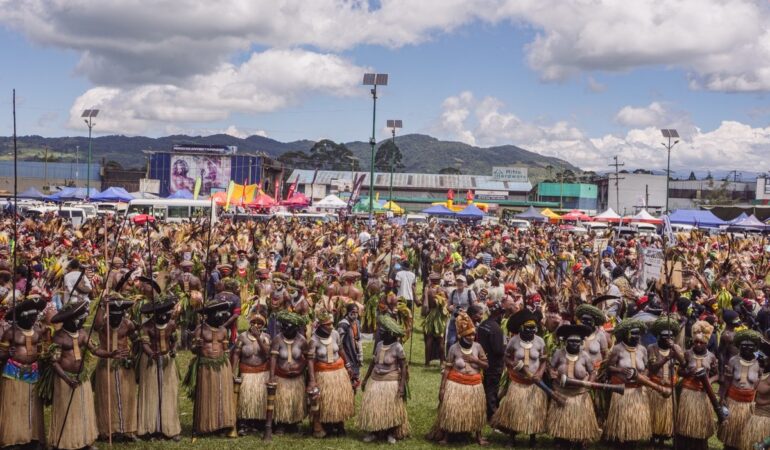
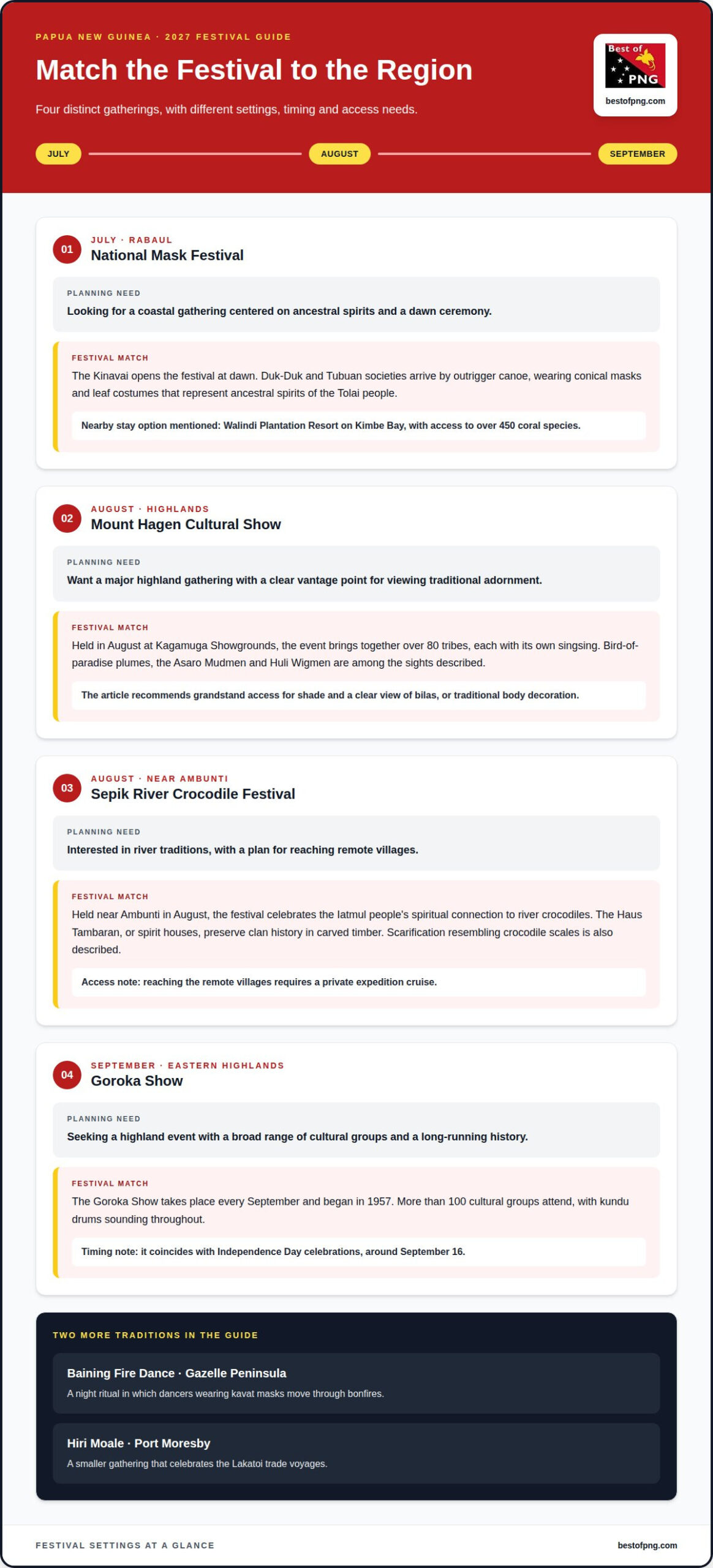
    The 2027 Mount Hagen Cultural Show takes place in August at the Queens Park Showgrounds, with headdresses and Bird of Paradise plumes throughout. Over 100 tribal groups participate, each with its own singsing. The Huli Wigen and Melpa warriors are a regular highlight. We always book VIP passes with grandstand access, which offers shade and a clear view for photographing the bilas, or traditional body decoration. We offer four and seven-night trips which can be combined with other escorted tours to other regions.

    Goroka Show: A Long-Running Gathering

    Every September, the Eastern Highlands capital hosts the oldest cultural event in the country, which began in 1957. The Goroka Show falls in mid to late September. More than 140 cultural groups attend, and kundu drums sound throughout. We offer four and eight-night trips for Goroka, which can be linked to other trips to the Sepik and East New Britain.

    Beyond the Highlands: Coastal and Riverine Traditions

    The coastlines and rivers offer a different view of the islands. The Papua New Guinea cultural festivals found here are shaped by the water. These celebrations differ from the warrior themes of the mountains. They reflect a world where spirits are said to dwell in the surf and the crocodile is highly revered.

    The National Mask Festival: Spirits of the Sea

    Dawn in Rabaul begins with conch shells across the harbor. This is the Kinavai, the opening ceremony of the National Mask Festival held every July. The Duk-Duk and Tubuan secret societies arrive on outrigger canoes. Their conical masks and leaf costumes represent ancestral spirits of the Tolai people. Many travelers combine the festival with a stay Rapopo Plantation Resort and WW2 history tours, a volcano hike, and a day trip to the Duke of York Islands.

    The Sepik River Crocodile Festival: Sacred Bonds

    The Sepik River Crocodile Festival takes place near Ambunti in August. The event celebrates the Iatmul people’s spiritual connection to the river’s crocodiles. The festival offers a look at the Haus Tambaran, or spirit houses, where clan history is carved into timber. You will see scarification, in which the skin of young men is cut to resemble crocodile scales. Reaching these remote villages requires a private expedition cruise, so your visit to these Papua New Guinea cultural festivals is respectful.

    The Baining Fire Dance of the Gazelle Peninsula is a night ritual in which dancers in kavat masks move through bonfires. For smaller gatherings, the Hiri Moale in Port Moresby celebrates the Lakatoi trade voyages. These events focus on the continuity of a culture that has lasted for millennia.

    A Journey Through Time: The Ultimate Guide to Papua New Guinea Cultural Festivals in 2027

    2027 Group Tours

    Below are our 2027 group tours; see all of them on our scheduled tours page. The three August escorted tours are designed to be taken back-to-back to form a longer itinerary covering different regions, from the coast to the river to the highlands. In September, three more can be combined to cover the Sepik River, the highlands and the Goroka festival, and East New Britain.

    4-Night East New Britain Explorer, 29 July to 2 August 2027

    Four nights based at the beachside Rapopo Plantation Resort. The tour includes WW2 history, a short hike up a volcano, snorkeling on reefs, swimming with dolphins, a visit to the Duke of York Islands, and the Bainings Fire Dance. View the itinerary.

    • Bayside Room: single $1,919 USD; double $1,595 USD per person sharing; twin $1,676 USD per person sharing.
    • Poolside Premier: single $2,049 USD; double $1,622 USD per person sharing; twin $1,725 USD per person sharing.

    Sepik River Expedition and Crocodile Festival, 3 to 9 August 2027

    Six nights, two in hotels and four in village guesthouses, fully escorted to the Upper Sepik for sing-sings, spirit houses, the Sepik Crocodile Festival, and local interactions. View the itinerary.

    • $2,849 USD per person sharing.
    • Single room supplement for the two nights in Wewak: $297 USD.

    Hagen Highlands Tribes Tour, 9 to 16 August 2027

    Seven nights fully escorted across the Highlands from Goroka to Mount Hagen. The tour includes village visits, a market, birds of paradise, the Paiya Show, the Mount Hagen Festival, and some private sing-sings. View the itinerary.

    • Per person sharing: $3,410 USD.
    • Single supplement: $462 USD.

    Mount Hagen Festival 4-Night Highlander Stay, 12 to 16 August 2027

    Four nights for the Paiya Show, birds of paradise, and the Mount Hagen Festival, at the Highlander Hotel. View the itinerary. Price: $2,860 USD per person sharing.

    Planning Your Voyage: Logistics, Timing, and Etiquette

    To see Papua New Guinea cultural festivals, plan the journey early. Securing your place for the 2027 festival season should begin at least 12 months in advance. Lodge capacity in highland hubs like Mount Hagen or Goroka is limited and often fills well before the festivals. Tourism infrastructure is limited, and international travelers often rely on full-service agencies like Brothers International Tours & Trading Pte Ltd to coordinate complex regional flight connections and transit arrangements.

    Internal travel relies mainly on Air Niugini and PNG Air. You will come across the idea of "Melanesian Time," where schedules follow the weather. Delays happen and flights shift. This is why flexible, guided itineraries are useful. Your packing list should cover two conditions. You’ll need:

    • Lightweight, moisture-wicking fabrics for coastal humidity that frequently hits 85 percent.
    • Insulated layers for Highland nights where temperatures regularly drop to 10 degrees Celsius.
    • Sturdy, waterproof footwear for navigating uneven, often muddy sing-sing grounds.

    Navigating the Wilds: Logistics and Internal Flights

    Port Moresby is the starting point for all festival routes. While scheduled flights reach major regional airports, private charters are often the only way to reach remote sing-sings in the Sepik or the Star Mountains. For more detail, see our guide on Safety and Logistics: What to Expect When Traveling to PNG.

    Respectful Immersion: Photography and Etiquette

    Your camera should be a tool for connection, not just capture. Always ask permission before taking a portrait. Remember that many Papua New Guinea cultural festivals involve dances that are ancestral rites rather than entertainment. Carry small denominations of Kina for local markets and small purchases.

    Ready to plan your trip? Book your 2027 festival tour with Best of PNG.

    Curating the Extraordinary: Your Bespoke Festival Expedition

    Traveling in rugged terrain takes local connections. For over 16 years, Best of PNG has built these relationships to support your visit to Papua New Guinea cultural festivals. Our team manages flights and permissions with local communities. We can combine the shows with diving in the Bismarck Sea, hiking up Mt Wilhelm, the highest peak in Oceania, or wildlife trips. For adventurous travelers who also explore other world-class wilderness frontiers, operators such as Nasikia Safaris offer guided wildlife expeditions and mountain trekking in East Africa.

    The Expert Advantage: Why Professional Guiding Matters

    A festival is easier to follow with context. Our guides explain the symbolism of the Bilas, the shell money, and the ancestral stories of each tribe. We handle details from charter flights to security arrangements. Our 2027 itineraries are designed for those who value depth over speed. To book, enquire about our 2027 Cultural Show Tours and begin planning your visit to Papua New Guinea cultural festivals.

    Step Into the Living History of 2027

    The 2027 season is a good opportunity to see Melanesian heritage. You have read about the Mount Hagen and Goroka Shows, the Sepik, and the coastal festivals. With over 25 years of expedition planning, Best of PNG handles the logistics of Papua New Guinea cultural festivals. Our itineraries, prepared with Indigo Safaris, include stays at Ambua Lodge and Walindi Plantation Resort. Explore our 2027 Mount Hagen and Goroka Show Tour Packages.

    Frequently Asked Questions

    When is the best time to visit Papua New Guinea for cultural festivals?

    August and September are the main months of the festival calendar. They fall in the dry season, so the Highlands are easier to reach. Most travelers visit during these two months for the Mount Hagen and Goroka shows, when the weather is most reliable.

    Is it safe to attend the Mount Hagen or Goroka Shows as a foreign tourist?

    Attending these shows is considered safe when you travel with an experienced tour operator who provides local escorts. We plan every movement so you can focus on the festival.

    How far in advance should I book a PNG cultural festival tour?

    You should book at least eight months before departure. Lodges in the Highlands often have fewer than 20 rooms, so places fill early. Booking a year ahead secures your place at Papua New Guinea cultural festivals.

    What should I wear when attending a sing-sing in the Highlands?

    Wear breathable layers and sturdy walking shoes for the grassy showgrounds. Temperatures in Mount Hagen range from 25°C at midday to 12°C later in the day. Respectful attire matters to the performers, who spend weeks preparing their bilas.

    Can I take photographs of the performers at the festivals?

    You are welcome to photograph the performers, but offer a nod or ask permission first. Most participants in these Papua New Guinea cultural festivals take pride in their appearance and will pose for a portrait. We recommend bringing 3 spare batteries and 2 high-capacity memory cards.

    Are there family-friendly cultural festivals in Papua New Guinea?

    Yes, the Highland shows are great fun for children.

    What is the difference between the Mount Hagen and Goroka shows?

    The Mount Hagen Show takes place in August and is often described as more intense, while the Goroka Show in September is the oldest event in the country. Goroka attracts over 140 tribal groups.

    Do I need a visa to visit Papua New Guinea for a festival in 2027?

    You will likely require an e-visa for your 2027 trip; check the official PNG Immigration and Citizenship Authority website for current 60 day visitor requirements. Since 2024, most international visitors must apply through the online portal at least 6 weeks before travel. We assist our guests with these  steps of the application process.